REVIEW · TAKAMATSU
Art Island Naoshima BROMPTON Slow Cycling Tour
Book on Viator →Operated by BROMPTON SLOW CYCLING TOURS · Bookable on Viator
Naoshima gets under your skin fast. This BROMPTON slow cycling tour pairs an easy riding pace with the island’s art neighborhoods, starting from Takamatsu and ending with sunset on the Seto Inland Sea. I like the way the guide keeps the day genuinely relaxed, so you can enjoy side streets instead of rushing past them. The one thing to plan around is extra costs for the ferry and major ticketed art stops, plus you’ll want decent weather since the tour is weather-dependent.
What really makes it click is the setup: a British-made folding Brompton, public transportation plus ferry, and a route designed for wandering. I also love that it’s small, with a maximum of 6 people, so your group doesn’t feel like a conveyor belt moving between photo spots. The other consideration: you should have a moderate fitness level, and you’ll still want to take your time on hills and transfers.
If you’re picturing a hardcore cycling workout, skip that idea. This is slow cycling with enough stops to let Naoshima’s art sink in—especially around the Honmura side and the House Project area. Expect a memorable day, but budget time and yen for the add-ons like Chichu Art Museum and the Art House Project.
In This Review
- Key highlights you’ll care about
- What Your $129 Covers (and What Costs Extra)
- Start at Takamatsu Port (and Why the Timing Works)
- The Brompton Advantage: Folding Bike Comfort Without the Ego
- Ferry to Naoshima: The Warm-Up Before the Art
- Akakabocha: Start Easy, Find the Island Mood
- Honmura and the House Project: Back Alleys With Big Atmosphere
- Chichu Art Museum and Benesse House: Plan Your Ticket Time
- Stop 2: Art House Project (and How It Fits the Day)
- Ride Back to Miyanoura, Then Ferry Home With Sunset
- The Real-World Pace: Easy Enough for Non-Cyclists
- Who This Tour Suits Best (and Who Should Rethink It)
- Should You Book This Naoshima Brompton Tour?
- FAQ
- What is the duration of the Art Island Naoshima BROMPTON Slow Cycling Tour?
- Where is the meeting point, and what time does the tour start?
- Do I need to bring my own bicycle?
- Is the ferry included in the tour price?
- Are museum tickets included?
- What does the tour cost cover?
- How many people are in each group?
- What should I know about fitness level?
- What happens if the weather is poor?
Key highlights you’ll care about
- BROMPTON folding bikes + easy pace: you get the feel of cycling without turning it into a fitness test
- Small group (max 6): more patience, more checking in, less pressure
- Ferry with your bike: you transfer from Takamatsu to Naoshima without leaving your wheels behind
- Naoshima art in two modes: street-level photo stops plus ticketed spatial art options
- Return route changes up the scenery: the second half isn’t just a replay
- Sunset on the Seto Inland Sea: a satisfying finish after museums and lanes
What Your $129 Covers (and What Costs Extra)
The price is $129 per person, and it covers two core pieces: the bicycle rental fee and the guide fee. That matters because it means you’re paying for the experience design—bike logistics, route planning, and someone steering your day—rather than just getting a bike and going solo.
On top of that, you’ll want to budget for a few things that are not included:
- Round trip ferry: 990 yen
- Chichu Art Museum: 2,100 yen
- Art House Project: 1,050 yen
- Lunch / souvenirs (your choice)
- Tour insurance: 500 yen
So is it good value? For me, it is if you plan to do at least one ticketed art experience and you like the idea of showing up already knowing where to go. If you’re hoping to spend most of the day only on free street art and skip museums, you might decide the add-ons push the total higher than you want.
Also, the tour uses a mobile ticket, which tends to make check-in smoother than older paper systems.
Start at Takamatsu Port (and Why the Timing Works)
You’ll meet at Takamatsu Port 8 Sunport at 9:45 am, and the tour ends back at the meeting point. The full day runs about 8 hours.
Why this timing is smart: it gives you enough daylight to cover both sides of the island and still leave room for museum ticketing and wandering. Naoshima’s art works tend to reward unhurried time. If you try to stack it with late starts, you’ll feel rushed when ticketed spaces get tight.
One more practical note: the meeting point is listed as near public transportation, so you’re not stuck arranging complicated private transfers just to begin.
The Brompton Advantage: Folding Bike Comfort Without the Ego
This tour is built around BROMPTON—British-made folding bikes. That changes the day in a very real way. You’re not managing a bulky “real bike” for the full island. Folding bikes are easier to handle around ports, on and off ferry movement, and in tight streets where you’ll be turning often.
The tour also isn’t framed as a technical cycling challenge. The guide supports you so you can enjoy the day even if you’re not an experienced cyclist. One review calls out how fun the Bromptons were, and that’s the big takeaway: you’re using the bike to extend your range, not to prove stamina.
Do bring realistic expectations, though. You still need a moderate physical fitness level, and you’ll want comfortable shoes for walking segments between art stops.
Ferry to Naoshima: The Warm-Up Before the Art
You take the ferry from Takamatsu Port to Naoshima’s Miyanoura Port with your bike. That detail is bigger than it sounds. It means you’re not planning a car-style transit puzzle or trying to figure out what to do with your bike after arrival.
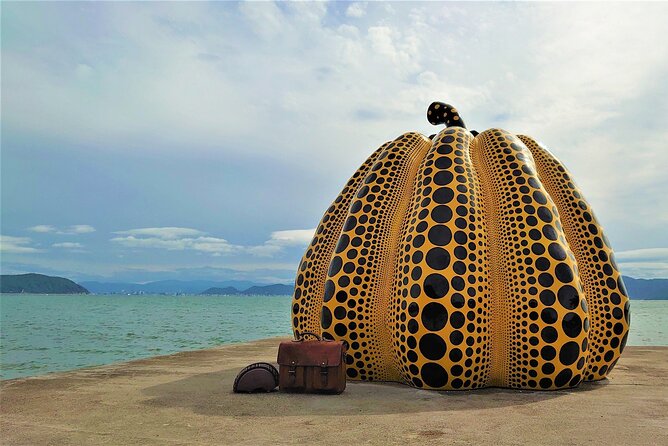
As you land at Miyanoura, you’re greeted by Naoshima’s famous red pumpkin symbol. That’s a fun way to flip the mental switch from transit mode into art-island mode.
If you’re the type who likes momentum, this ferry segment sets it up well: you arrive ready to walk, bike slowly, and stop for photos without feeling like you just started your day in motion.
Akakabocha: Start Easy, Find the Island Mood
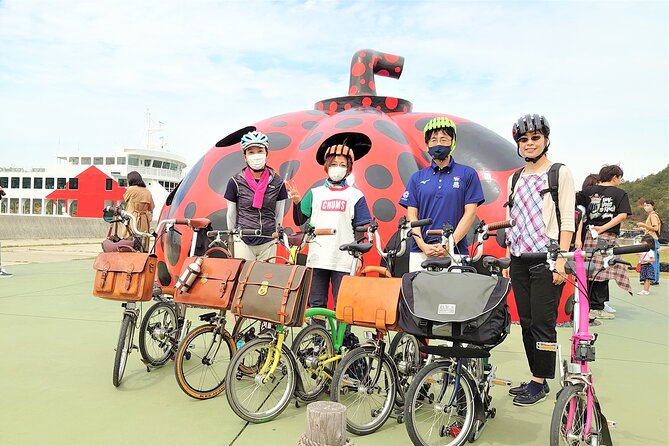
Stop 1 is Akakabocha. This is where you begin blending into Naoshima’s visual language rather than jumping straight into ticketed museums.
You can expect a mix of casual exploring and photo-ready art vibes. A big part of Naoshima is how scattered works feel across the town—sometimes right where you didn’t expect them—so beginning with an easy-to-enter area helps you get your bearings fast.
Even if you care more about museums than street art, this early stop is useful. It helps you learn how the island lays out its lanes, how the walking-bike pattern works, and when you’ll want to pause for photos.
Honmura and the House Project: Back Alleys With Big Atmosphere
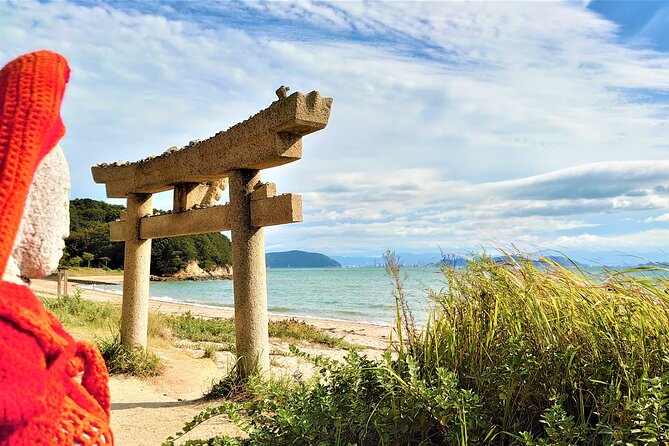
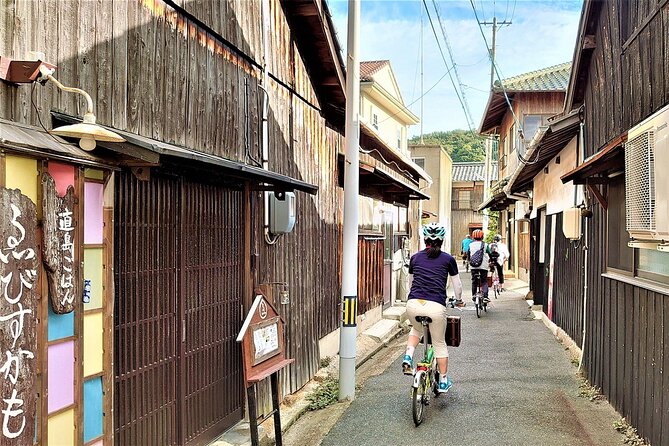
From there you head toward Honmura, on the island’s east side. This is the part of Naoshima many art lovers talk about because of its House Project feel—intricate back alleys, small turns, and art that you experience through space, not just viewing distance.
This is also where slow pacing pays off. With a slow cycling structure, you can stop at your favorite shops, take your time through street art, and notice details that you’d miss if you were moving like you were racing the clock.
What you’ll like here:
- lots of small discoveries rather than one single “big show”
- a walking-and-stopping rhythm that feels natural
- the chance to match your pace to the art mood
The only downside is that this kind of wandering is tiring if you try to cover everything fast. The tour’s point is to avoid that. If you let the day breathe, Honmura becomes the memory-maker.
Chichu Art Museum and Benesse House: Plan Your Ticket Time
The tour includes the option to visit the Chichu Art Museum and Benesse House Museum. These are ticketed stops, and Chichu is listed at 2,100 yen. (Benesse House Museum costs are not listed in the info you provided, so you’ll want to check what applies for your chosen visit.)
Why these stops matter: they’re internationally renowned for spatial art. That means you’re not just looking at objects—you’re experiencing how architecture, light, and room layout change your perception.
Practical advice for ticketed stops:
- give yourself time to settle in before moving to the next room
- don’t treat it like a checklist
- keep some energy for after, since the day still ends with a ferry ride and sunset
In one review, someone praised the overall mix of many museums and artworks in a single day. That’s the advantage of having a guide map the flow—ticketed art becomes reachable without you trying to build a perfect schedule from scratch.
Stop 2: Art House Project (and How It Fits the Day)
Stop 2 is listed as the Art House Project. On Naoshima, that name connects to the island’s house-based art concept and the experience of walking through small curated spaces.
This is also where the ticketed nature of Naoshima becomes clear. The Art House Project is listed at 1,050 yen and is not included in the base price.
If you’re trying to decide whether to add it: I’d base it on how you like art that changes with perspective and movement. If you enjoy walking through environments and noticing how space directs you, this is the kind of add-on that feels worth it.
If you mostly want the outdoor photo spots and a light day, you might choose fewer paid entries. Either way, the tour’s routing is designed so you’re not just buying tickets—you’re also enjoying the “between” moments.
Ride Back to Miyanoura, Then Ferry Home With Sunset
For the return, you take a different route back to Miyanoura Port. That’s a smart move. Cycling the same path twice can feel repetitive fast, especially on an art island where small visual changes matter.
Then you ferry back to Takamatsu Port. The best part of the ending is the planned view: sunset over the Seto Inland Sea while you’re on the water.
One review also mentions strong wind during the tour, which is believable on islands and across open water. So yes—bring a light layer you can pull on during cooler breezes.
The Real-World Pace: Easy Enough for Non-Cyclists
The big promise here is that you don’t need to be a confident cyclist. The guide supports you, and the tour is built to be leisurely.
The reviews back up how it feels in practice. One review calls out the helpful and friendly guiding, and another specifically says the guide (Takashi) went at their slow pace. That’s exactly what you want on Naoshima. A rigid schedule would clash with how these works reward patient attention.
You still want moderate fitness. The bike helps you cover ground, but you’ll also be walking and moving between zones.
My advice: if you can comfortably do a day with some walking and slow cycling, you’ll be fine. If not, you can still enjoy Naoshima, but consider doing fewer paid spaces and leaning harder into the town-level art.
Who This Tour Suits Best (and Who Should Rethink It)
This tour fits best if you want:
- a guided way to see a lot without rushing
- Brompton fun without bike anxiety
- a mix of town art and ticketed museum experiences
- a small group day with a guide who keeps you on track
It might not be ideal if:
- you’re trying to do everything with minimal added costs (ferry + ticketed art can add up)
- you dislike any walking involved in art-house areas
- you’re extremely sensitive to weather changes, since the tour depends on good weather
If you’re a couple traveling together or booking as a small group, the “reservations for two persons or more” setup also makes it easier to line up with your travel plans.
Should You Book This Naoshima Brompton Tour?
I think you should book if your ideal Naoshima day looks like this: ferry over, slow ride on a folding bike, time for street-level art wandering, and one or two ticketed experiences before a sunset ferry ride home. The combination is practical and fun—especially the small group size and the guide pace. If you’ve been overwhelmed trying to plan Naoshima on your own, this tour turns it into a smooth, art-first day.
I’d pause before booking if you’re only interested in free street art and don’t want to pay for ferry or museums. Also, check your comfort with a moderate fitness day that includes biking plus walking.
If you do decide to go, I’d book with some lead time. The tour is commonly booked about 55 days in advance, and with a maximum of 6 people per group, popular dates can disappear.
FAQ
What is the duration of the Art Island Naoshima BROMPTON Slow Cycling Tour?
It runs for about 8 hours.
Where is the meeting point, and what time does the tour start?
You meet at Takamatsu Port 8 Sunport in Takamatsu at 9:45 am, and the tour ends back at the same meeting point.
Do I need to bring my own bicycle?
No. The bicycle rental fee is included.
Is the ferry included in the tour price?
No. The round trip ferry costs 990 yen and is not included.
Are museum tickets included?
Chichu Art Museum is not included (2,100 yen). The Art House Project is not included (1,050 yen). Benesse House Museum is mentioned as a possible stop, but its price is not listed in the provided details.
What does the tour cost cover?
Your $129 price covers the bicycle rental fee and the guide fee.
How many people are in each group?
The tour has a maximum of 6 travelers.
What should I know about fitness level?
You should have a moderate physical fitness level. The guide supports you, and the pace is leisurely.
What happens if the weather is poor?
The experience requires good weather. If it’s canceled due to poor weather, you’ll be offered a different date or a full refund.