REVIEW · SEVILLE
Guided Electric Bicycle Tour of Seville
Book on Viator →Operated by Spain Cycling Tours · Bookable on Viator
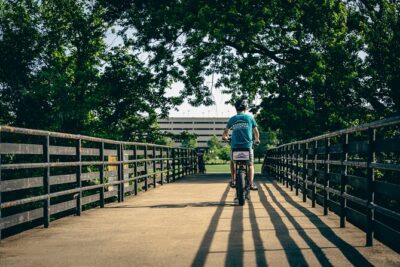
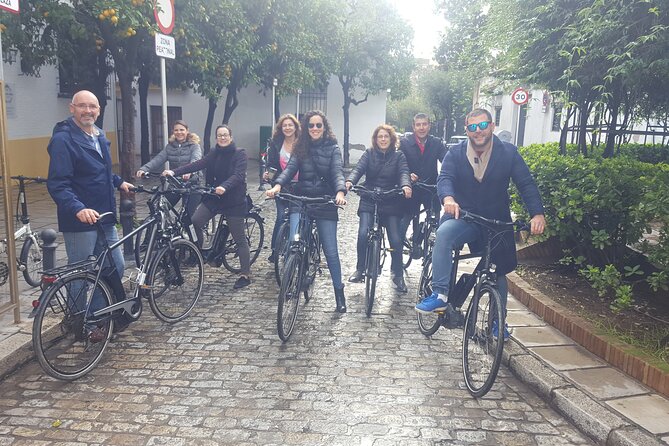
Seville looks different at bike speed. I like this tour because the electric bike makes the ride easy, and the guides (like Rigo and Elena) bring the sights to life with real, on-the-spot context. I also like that the route is built for cruising, not sprinting—so you actually enjoy stopping at each big landmark.
The ride is also described as easy and safe, with most of the time spent in bike lanes or through parks. The main thing to watch is timing and weather: the tour requires good weather, and the 2.5–3 hours can feel busy if you want to linger too long at every stop.
In This Review
- Key highlights you’ll feel right away
- Electric bikes make Seville easier on your legs
- Where the tour starts (and how the timing works)
- Parque de Maria Luisa: Seville’s garden break
- Puente de Isabel II: crossing the Guadalquivir on Triana Bridge
- Plaza de España: designed for walking, even on a bike tour
- Seville’s Cathedral and Giralda: from the old mosque to the bell tower
- Real Alcázar: the royal palace that still lives in Europe
- Ayuntamiento and Torre del Oro: renaissance detail and river defense
- Price and value: why $53.61 can make sense here
- Should you book this Seville electric bike tour?
- FAQ
- How long is the Guided Electric Bicycle Tour of Seville?
- How much does the tour cost?
- Is the tour offered in English?
- What group size should I expect?
- Where is the meeting point?
- Will there be bike lanes or mostly off-road riding?
- Are the admissions for the sights included?
- What happens if the weather is poor?
- Can I cancel for a full refund?
Key highlights you’ll feel right away
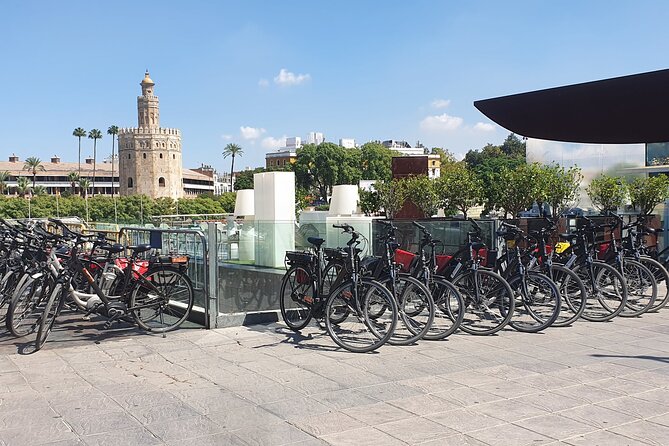
- Electric bike comfort: smooth assist if you pedal lightly, so you’re not wiped out after the first kilometer
- Small group size (max 15): you get personal attention without feeling herded
- Free entry at major stops: every listed stop has admission ticket free
- Big-picture Seville in one loop: parks, bridges, UNESCO-level monuments, and river views
- Guides with personality: Rigo, Pablo, Garmin, Elena, and Alejandro-style enthusiasm shows up in the experience
Electric bikes make Seville easier on your legs
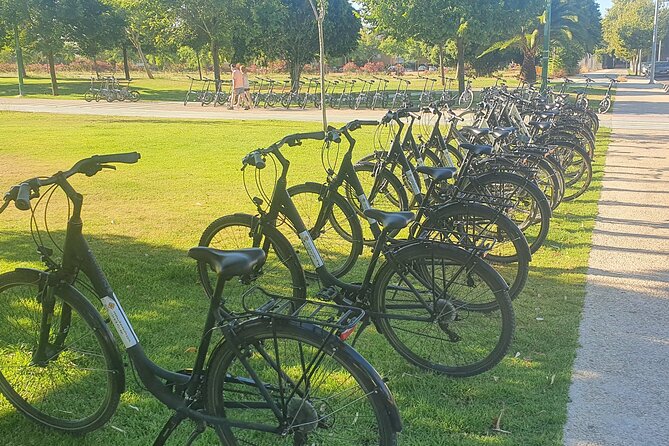
Seville has layers. You feel it in the streets, and you’ll feel it fast on this route. The big win here is the e-bike: it takes the sting out of hills and keeps the pace relaxed enough that you can still read the buildings and photos don’t blur from rushing.
You’ll also appreciate how the tour is set up for safety and flow. The route is described as mostly bike lane riding or passing through parks, which means fewer stressful moments and more chances to enjoy the scenery. If you’re the type who likes your sightseeing guided but not exhausting, this fits.
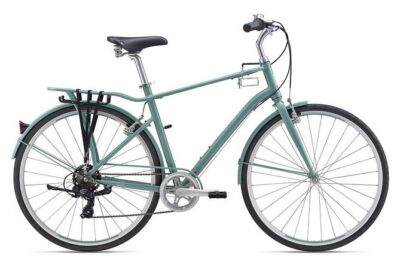
One practical tip: think of the motor as help, not a replacement. The experience is described as smooth and able to do most of the work if you pedal lightly. So wear comfortable shoes, keep a steady rhythm, and don’t try to “conquer” the ride—just guide it.
You can also read our reviews of more tours and experiences in Seville.
Where the tour starts (and how the timing works)
You meet at Spain Cycling Tours on C. San Jorge, 23, 41010 Sevilla. The tour ends back at the same meeting point, so you’re not left figuring out transport after you’ve finished your last photo stop.
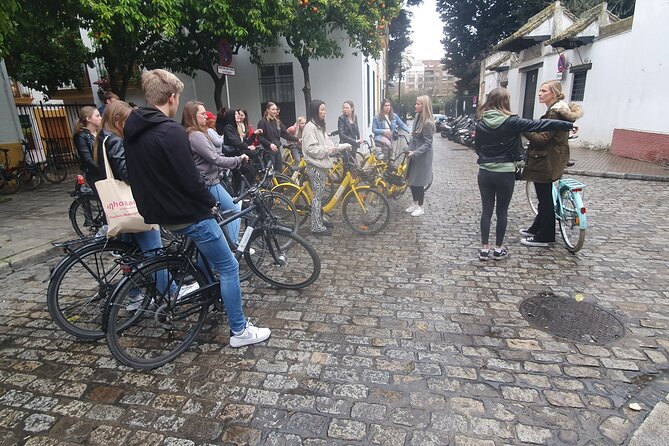
Expect about 2 hours 30 minutes to 3 hours total. With one stop timed at 30 minutes and another at 15 minutes, you get enough time at the major anchors without turning the day into a marathon. Since the group tops out at 15 people, it’s the kind of pace where the guide can keep everyone together while still answering questions.
It runs in English, uses a mobile ticket, and is offered on a guided format. Most people can participate, but because it depends on good weather, plan to bring a light layer and be ready to adjust if conditions aren’t ideal.
Parque de Maria Luisa: Seville’s garden break
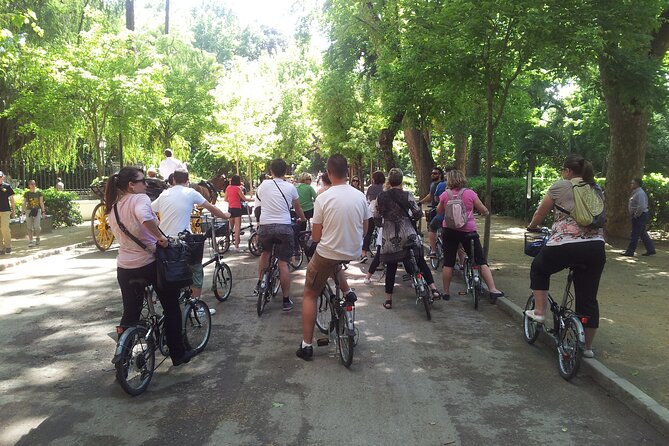
Stop 1 is Parque de Maria Luisa, a real breath of green in the city. The park is described as a lung of Seville, and it includes botanical-garden style space. You also get a sense of how Seville connects leisure and culture here—because the park ties to the Ibero-American Exposition of 1929 and includes gardens associated with the Palace of San Telmo.
What I like about starting here is the mental reset. After you mount the e-bike, you don’t immediately dive into crowds and stone. Instead, you ease into the day with open space and a calmer pace that helps you settle into the route.
Another plus: the stop is listed at 30 minutes and includes free admission. That matters because it removes the friction of planning around paid entries. You can focus on observing—paths, views, and the park layout—without having to squeeze in a ticket purchase.
Potential drawback: because it’s a park stop, you’ll get the most from it if you slow down and watch where the paths pull your eyes. If you rush through for the next landmark, you’ll miss the point of the opening “breathing room.”
Puente de Isabel II: crossing the Guadalquivir on Triana Bridge
Stop 2 is the Puente de Isabel II, also known as the Triana Bridge. This bridge is a key connector in Seville because it joins the city center with the Triana neighborhood by crossing the Guadalquivir river.
Here’s a detail worth paying attention to: it replaced an older boat bridge, and it’s recognized as the oldest preserved iron bridge in Spain. Construction ended in 1852 under the reign of Isabel II, which is exactly how the bridge got its name.
This stop works as more than a photo moment. It’s your geographic cue for what comes next: Seville’s riverfront story is everywhere, and the bridge gives you a clean line across the water before you transition into the monumental core.
The admission ticket is listed as free, so you’re not paying to understand the significance—you’re paying in effort (minimal) and using your senses (weather, river air, river views) to take it in.
If you’re someone who dislikes long bridges or windy crossings, you’ll probably still enjoy this one because it’s a short stop and it’s tied to a strong story you can repeat while you roll onward.
Plaza de España: designed for walking, even on a bike tour
Stop 3 is Plaza de España, located in the María Luisa park. It was designed by Aníbal González and built between 1914 and 1929 as a major construction for the Ibero-American Exposition of 1929.
What makes this stop feel rewarding on an electric bike tour is that it’s still structured for strolling. You’re not just passing by. You get a 15-minute window to orient yourself, take in the scale, and understand why this plaza has become a signature symbol of Seville.
The details also matter. Plaza de España is described as the largest building of all those built in Seville during the 20th century, and it’s comparable to other standout constructions outside the city walls, including the Hospital of the Five Wounds and the Royal Tobacco Factory. That gives you a way to place it in Seville’s larger architectural story.
Admission ticket is listed as free, so you don’t have to pre-plan around fees. That makes Plaza de España feel less like a checklist item and more like a stop you can actually enjoy.
Potential drawback: fifteen minutes can vanish fast here, because the plaza invites photos from multiple angles. If you want a perfect shot, pick one viewpoint and get it quickly. If you want the “feel,” spend more time watching how the space stretches around you, not just photographing it.


Seville’s Cathedral and Giralda: from the old mosque to the bell tower
Stop 4 is the Catedral de Sevilla (Santa María de la Sede y de la Asunción). This is the Gothic-style cathedral Church in Seville and one of the largest Gothic cathedrals in the world by that style. UNESCO recognized it in 1987, along with the Real Alcázar and the Archivo de Indias, as a World Heritage Site.
Here’s the key storyline you’ll hear as you ride: the cathedral was built on the site left after the demolition of the old mosque Aljama of Seville. The text notes that the Giralda and the patio Patio de los Naranjos are still preserved. So even when the architecture shifts across centuries, the place remembers what was there before.
Stop 6 focuses on Torre Giralda, the bell tower of the cathedral. The lower part corresponds to the minaret of the old city mosque from the end of the 12th century (Almohad period), while the upper part is a Christian-era construction from the 16th century. At the peak sits the bronze Giralaldillo, a weathervane symbol tied to the Triumph of Faith.
The tower’s height is given as 94.69 meters. That number helps you understand why it dominates the skyline, even from street level.
Admission is listed as free for both the cathedral and Giralda. That’s important because it lets your focus stay on understanding rather than payment. You can see the “why” behind what you’re looking at—Giralda as a physical link between eras—without needing to time budget around ticket costs.
Potential drawback: if you expect to spend a long time inside everything, this won’t be the slow, full-detail experience. It’s built for a guided ride with multiple stops. Come ready to absorb highlights, not to linger for hours.
Real Alcázar: the royal palace that still lives in Europe
Stop 5 is Real Alcázar de Sevilla, a walled palatial complex built in multiple historical stages. The original palace dates to the High Middle Ages, and the complex preserves traces of Islamic art. After the Castilian conquest, the text notes Mudejar and Gothic palatial spaces, and later reforms added Renaissance, Mannerist, and Baroque elements.
This stop matters because it explains Seville’s identity through layers you can actually see. You’re not just looking at one style—you’re seeing how different rulers shaped the same site over time.
The tour highlights the outer wall and Lion gate. The Real Alcázar is also described as the residence of Spanish royal family members when they visit Seville, which is why it’s labeled as the oldest royal palace in use in Europe. UNESCO recognized it in 1987, and the site also pulls serious visitor numbers, with 2,067,016 visitors in 2019.
Admission is listed as free. That makes a huge difference in perceived value. Even if you already know the basics, you’re still getting access to one of the city’s big “musts” without feeling punished by entrance fees during a short guided loop.
Possible consideration: since it’s a major landmark, you may want to be selective about what you focus on—outer wall details at the Lion gate, or the general palace layout. With limited time, trying to take in everything at once can lead to information overload.
Ayuntamiento and Torre del Oro: renaissance detail and river defense
Stop 7 brings you to Ayuntamiento (the City Hall), described as a notable example of Renaissance architecture with minute decoration called Plateresque. It sits in Plaza Nueva and began construction in the 16th century under Diego de Riaño. The description also names parts of the town hall complex, including the Chapter House and the Hall of Faithful Executors.
The tour also points out how the building changed over time. It was enlarged in the 19th century by Demetrio de los Ríos and Balbino Marron, who drew up a new main facade oriented toward Plaza Nueva in a neoclassical style. If you like seeing how cities revise themselves rather than freezing in one era, this stop gives you that angle.
Then you move to Stop 8: Torre del Oro, a watchtower on the left bank of the Guadalquivir. It’s from 1221, with construction ordered between 1220 and 1221 by the Almohad governor Abù l-Ulà, and it was handed over to the city on February 24, 1221. The tower’s height is listed at 36 meters.
This tower is also a survivor story. It was declared a historic-artistic monument in 1931 and restored multiple times, including restorations noted for 1900, 1991–1992, 1995, and 2005. The text adds that the Navy’s work mattered for conservation. Today it houses the Naval Museum of Seville.
Admission is listed as free. That’s a strong match for the tour’s overall value: you’re getting a mix of official civic architecture and river defense history, all within the same short guided ride.
Potential drawback: Torre del Oro is more about context and structure than about big interior time. If you want a long museum-style stop, you might find the time brief. Still, for a first pass and good photo angles, it’s a smart capstone.
Price and value: why $53.61 can make sense here
The tour costs $53.61 per person and runs about 2.5–3 hours. On paper, that might sound like a splurge—until you compare it with what you’re actually getting in the time window.
First, this tour is built around a guided format on an electric bike, which is what makes the “see a lot without suffering” promise real. Second, the group is capped at 15 travelers, so your guide can keep the energy up and answer questions. Third, every listed stop has admission ticket free, including the cathedral, Giralda, Real Alcázar, and the other major monuments.
That free-entry detail is where the math starts to tilt in favor of the tour. You’re paying for guiding and transportation, not for a pile of attraction tickets on top. When the itinerary includes multiple UNESCO-scale sites and big city symbols, a single guided pass can feel like good use of limited time.
Who this tour suits best:
- First-time visitors who want orientation fast
- People who can ride a bike lightly but don’t want to do the whole city on foot
- Anyone who likes history told in plain language, with guide energy (Rigo, Garmin, Pablo, Elena, Alejandro style)
If you prefer unguided wandering, this might not fit your style. But if you want a structured route that still feels relaxed, it’s an efficient way to get the essentials with context.
Should you book this Seville electric bike tour?
If you’re aiming to see Seville’s top monuments in one go without draining your legs, I’d book it. The combination of electric bike ease, a route described as safe and mostly in bike lanes or parks, and the mix of major landmarks with free admission makes the value pretty clear.
One final decision check: if the forecast looks shaky, don’t force it. This experience is dependent on good weather, and that can affect your plans. If the day looks good, you’ll likely feel like you covered a lot of ground while still enjoying the city at a human pace.
FAQ
How long is the Guided Electric Bicycle Tour of Seville?
It lasts about 2 hours 30 minutes to 3 hours.
How much does the tour cost?
The price is $53.61 per person.
Is the tour offered in English?
Yes, it’s offered in English.
What group size should I expect?
The maximum group size is 15 travelers.
Where is the meeting point?
The tour starts at Spain Cycling Tours, C. San Jorge, 23, 41010 Sevilla, Spain.
Will there be bike lanes or mostly off-road riding?
The route is described as mostly in bike lanes or through a park, and the e-bike ride is said to be smooth.
Are the admissions for the sights included?
The stops listed for the tour show admission ticket free.
What happens if the weather is poor?
The tour requires good weather. If it’s canceled due to poor weather, you’ll be offered a different date or a full refund.
Can I cancel for a full refund?
Yes. You can cancel up to 24 hours in advance for a full refund.