REVIEW · HIROSHIMA
Okunoshima Rabbit Island Cycling Tour with Local Guide
Book on Viator →Operated by 竹原DMO · Bookable on Viator
Rabbit Island has a second, darker story. This cycling tour on Okunoshima mixes the easygoing fun of wild rabbits with a guide who connects the dots to the island’s wartime concealment and ruins, all in about 2 hours. I like how it keeps things moving while still giving you time to look closely.
I also love the small-group feel, with a maximum of 5 people, plus the human touch of meeting your guide—Junko was especially warm and passionate in recent experiences. You’ll get a clear, guided explanation of how the rabbits became part of the island’s present story, not just a quick photo stop.
One thing to consider: several major sites are view-only from short distances because you can’t go inside (including the lighthouse and poison gas-related ruins). If you’re expecting a lot of inside exploration, you’ll need to adjust your expectations.
In This Review
- Key points worth your attention
- Okunoshima by bike: a fun ride that still tells the truth
- Getting started at KYUKAMURA OHKUNOSHIMA: quick, simple logistics
- Stop 1: Okunoshima Lighthouse, view-only but worth it
- Stop 2: Okunoshima Island cycling—4 km of rabbit sightings and sea air
- Stop 3: Okuno Shrine—where rabbits add a quiet twist
- Stops 4 and 5: poison gas storage ruins + power plant ruins—view them, don’t rush
- Stop 6: Northern Cannon Battery Remnants—where you can see closely
- Price and value: what $59.12 buys you (and what it doesn’t)
- The group size factor: shared tour, but not crowded
- Who should book this cycling tour (and who might pass)
- Should you book? My call
- FAQ
- How long is the Okunoshima Rabbit Island cycling tour?
- Where does the tour start and end?
- Is this tour private?
- What is included in the price?
- Do I need to pay admission at the stops?
- Is food included?
- Do I need to pay a ferry fee?
- What kind of physical fitness do I need?
- What happens if it rains?
- When can I cancel for a full refund?
Key points worth your attention
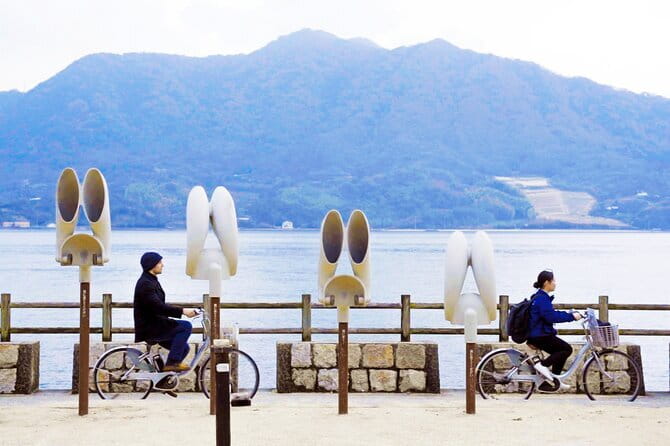
- Bike + guide in a compact 2-hour format: enough time to cover the island highlights without a full day commitment.
- Small group of up to 5: shared group, but you’re not stuck in a giant herd.
- Junko’s storytelling focus: she ties rabbit encounters to the island’s hidden wartime past.
- View-only access at key ruins: you’ll see important remnants from allowed vantage points.
- Wild rabbits are the main event: you’ll likely see them as you cycle and stop around the island.
- You’ll need decent weather: rain forecasts can cancel the tour based on Japan Meteorological Agency rules.
Okunoshima by bike: a fun ride that still tells the truth
Okunoshima sits in the Seto Inland Sea near Hiroshima, surrounded by a huge scatter of islands. In daylight, it feels peaceful fast. Wild rabbits have taken over the island’s public imagination, and you’ll see them as you ride and stop—often right where you’re standing.
But the island’s story isn’t only cute. Okunoshima was removed from maps because of wartime activity tied to chemical weapons production and storage. This tour’s value is that it treats both parts seriously: rabbits as living reality today, and ruins as the past you can’t ignore.
You’ll also appreciate that this is a shared group tour with a maximum of 5 travelers. That size keeps the pacing human. Your guide can explain as you go, instead of rushing everyone through “look and go.”
The tour runs about 2 hours and uses bicycles provided for you. Food isn’t included, so plan to eat before or after (and bring water if you tend to get thirsty while biking).
You can also read our reviews of more tours and experiences in Hiroshima.

Getting started at KYUKAMURA OHKUNOSHIMA: quick, simple logistics
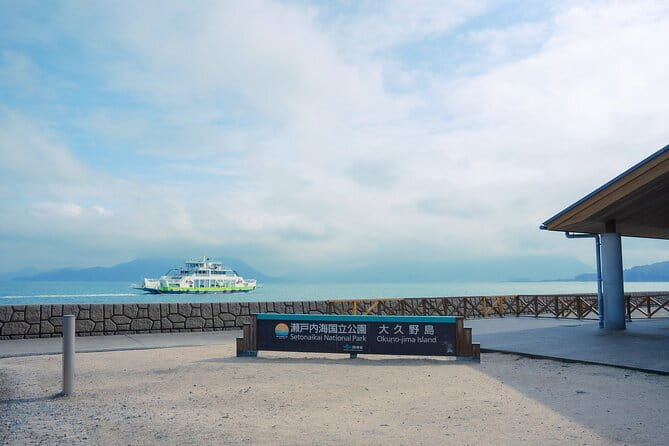
The tour meets at KYUKAMURA OHKUNOSHIMA in Tadanoumichō, Takehara, Hiroshima, and it ends in front of the same hotel. That’s helpful because you don’t have to figure out a complicated pickup point mid-island.
Because it’s a mobile ticket, you won’t be scrambling for paper vouchers. If you’re arriving by ferry, budget for the ferry fee: the Tadanoumi to Okunoshima ride is listed at 360 yen and isn’t included in the tour price.
Physically, expect moderate effort. You’re cycling a small island, not climbing mountains, but you still want to be comfortable with steady biking and short walks at stops.
Finally, keep an eye on the weather. If the Japan Meteorological Agency forecasts a 60% or higher chance of rain by 12:00 PM the day before, the tour is canceled with no cancellation fees. That means you should avoid planning a “must do no matter what” schedule for that same window.
Stop 1: Okunoshima Lighthouse, view-only but worth it

Your first stop is the Okunoshima Lighthouse. The catch is you can’t enter the lighthouse area. Instead, you’ll view it from a short distance.
So why bother? Because this is where the island starts to make sense geographically. You’re getting oriented to the coastline and the way the island sits in the Seto Inland Sea. Even without access, the lighthouse view helps you understand the island’s layout before you spend more time among the rabbits and the wartime remains.
You’ll also get a short break—about 10 minutes. That’s long enough to look, take a few photos, and settle your biking rhythm before you roll on.
If you’re the type who hates “outside only,” this is the first place you’ll feel that limitation. Still, it works as a setup stop, not a disappointment.
Stop 2: Okunoshima Island cycling—4 km of rabbit sightings and sea air
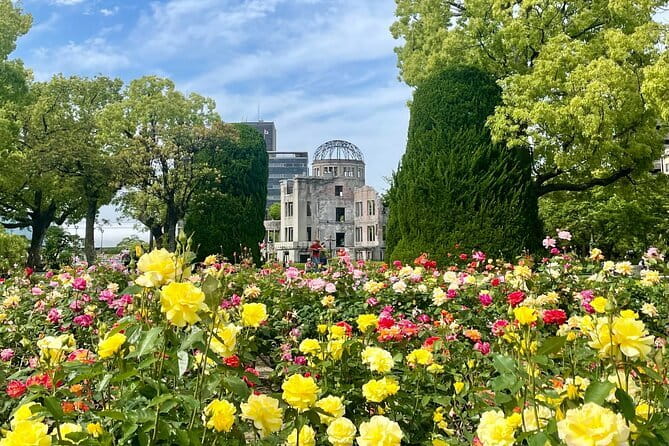
Next comes the main island segment. Okunoshima is small, with a circumference of about 4 km. You’ll ride and move around the island’s key areas, and you’ll spend about 1 hour here.
This stop is where the “Rabbit Island” part becomes real. You’re not just standing in one place waiting. As the bike moves, your rabbit encounters happen along your route. The island’s peace also lands differently while you’re moving—less like a zoo, more like you’re sharing space.
You’ll also be in a Seto Inland Sea National Park area. That matters because it explains why this kind of scenery and conservation-minded setting exists alongside the wartime ruins. The island isn’t themed for tourists only; it’s a lived-in place with natural features and history both present.
One practical tip: since the island is small, the best photos and best rabbit moments often come when you slow down. Don’t treat this as a “speed-run” stop. Let the guide’s pacing work for you.
Stop 3: Okuno Shrine—where rabbits add a quiet twist
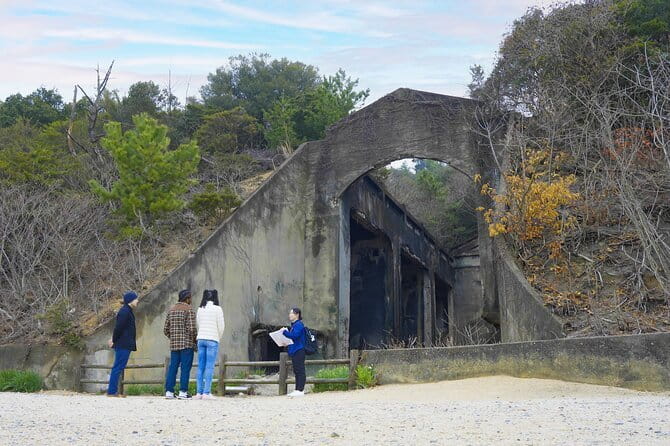
At the Okuno Shrine, you’ll stop for about 10 minutes. It’s the only shrine on the island, and it’s also now home to rabbits.
That combination is exactly why this stop feels memorable. You’re moving from views and open areas into a more focused cultural space. Then rabbits appear again, blurring the boundary between “historic sites” and “everyday island life.”
This is a short stop, so you’ll want to pay attention immediately rather than plan to do a full sightseeing circuit. Use the time for a quick look around the shrine area, a few calm photos, and a moment to notice how the rabbits behave in a quieter setting.
If you like details, this stop is a good payoff: it’s not only war-related context and not only bunny spotting. It’s the island’s present blended with its spiritual layer.

Stops 4 and 5: poison gas storage ruins + power plant ruins—view them, don’t rush

Two of the stops are connected to wartime chemical weapons production and storage remnants:
- Nagaura Poison Gas Storage Ruins (about 10 minutes)
- Power Plant Ruins (about 10 minutes)
For both, entry is prohibited for safety reasons. So again, you’re seeing structures from a short distance rather than walking inside or getting close enough to explore like a normal ruin.
Still, these stops are essential. This is where the tour earns its credibility. Rabbits can make the island look light, but the guide’s explanation keeps the tone honest. Junko’s storytelling has been praised for exactly this: tying the island’s dark wartime past to why Okunoshima was hidden and how that truth still lingers in the remnants you can view today.
The best way to experience these stops is to stop moving your eyes. Look at what’s there, then listen to what your guide says about what was used and why it was built. You’ll get more meaning if you treat these as interpretive stops rather than “ruin photo” stops.
Stop 6: Northern Cannon Battery Remnants—where you can see closely
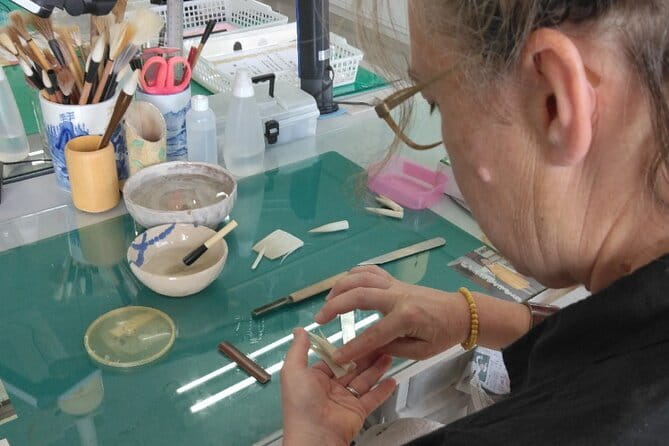
Your final stop is the Northern Cannon Battery Remnants for about 15 minutes. Unlike the lighthouse and the poison gas storage and power plant areas, this one lets you see the remnants more closely.
That extra access time helps you finish the tour with a stronger sense of scale and design. You’re getting closer to the physical reality of defensive infrastructure rather than only distant sightlines.
This is also a nice way to shift out of heaviness without erasing it. You still have wartime context in front of you, but the closer viewing helps your brain connect the island’s geography to how the structures may have been used.
If you’ve been watching rabbits the whole time, this is the moment you’ll likely feel the contrast the most: a quiet island surface with visible reminders below it.
Price and value: what $59.12 buys you (and what it doesn’t)
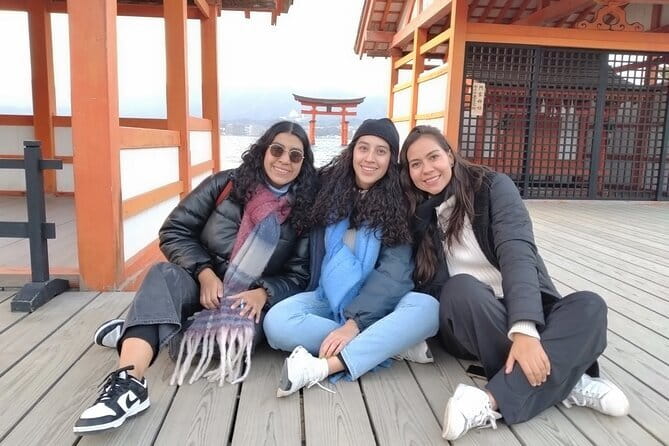
At $59.12 per person, this tour looks affordable on paper, but the real question is whether you’re getting the right mix of time, access, and guidance.
Here’s what you do get:
- Bicycle use included
- All fees and taxes
- Travel insurance included
- A local guide who explains both the rabbits and the island’s hidden past
- Admission tickets for the listed stops are marked as free
What you don’t get:
- Food and beverages
- Ferry fee (Tadanoumi to Okunoshima is listed at 360 yen)
- Private transportation
So the value is strongest if you want a guided structure for a short visit. You’re not paying extra for individual admissions, and you’re not paying for the bike rental. Insurance being included is a small detail, but it matters when you’re biking on a small island with unpredictable weather.
If you already plan to do the island on your own with your own bike and you don’t care about the wartime context, the price won’t feel as special. But if you want the story made understandable while you’re riding, the cost starts to make sense.
The group size factor: shared tour, but not crowded
This is a shared group tour, but the experience caps at 5 travelers. That combination is rare enough to notice.
In practice, you should expect:
- A bit of flexibility in pacing
- Enough space to hear your guide
- A less chaotic rabbit-viewing experience than you might fear
It’s also a reasonable duration. Two hours is long enough to see all the major designated stops and still feel like you did something. It’s short enough that it doesn’t require a full day of planning.
Who should book this cycling tour (and who might pass)
I think this tour is a strong fit if:
- You want the Okunoshima Rabbit Island experience with context, not just photos
- You like small-group guidance and a human voice doing the explaining
- You’re comfortable with moderate biking and short stops
You might skip it if:
- You’re expecting lots of inside access at ruins (several stops are view-only)
- You’re traveling during a period where rain is likely and you can’t change plans
- You need food provided on the spot (it isn’t included)
If you’re the kind of traveler who enjoys “two sides of a place,” this tour hits that sweet spot: rabbits plus the truth behind why the island was hidden.
Should you book? My call
If you’re visiting Hiroshima and you have even a small opening for an island day, I’d book this. Not because rabbits are “the main event,” but because the bike format makes you slow down enough to notice. And because the guide focus—like Junko’s emphasis on education about the terrible past—turns the island into more than a cute detour.
The one caution is the access style. Several big points of interest are view-only due to safety restrictions. If that will frustrate you, it may feel like a lot of looking from a distance. If you can accept that trade-off, you’ll likely leave with a sharper, more complete picture of Okunoshima.
FAQ
How long is the Okunoshima Rabbit Island cycling tour?
The tour lasts about 2 hours.
Where does the tour start and end?
It starts and ends in front of the hotel KYUKAMURA OHKUNOSHIMA (休暇村大久野島), at the same meeting point.
Is this tour private?
No. It is a shared group tour, with a maximum of 5 travelers.
What is included in the price?
Included are bicycle use, all fees and taxes, and travel insurance.
Do I need to pay admission at the stops?
The listed stops have free admission tickets.
Is food included?
No. Food and beverages are not included.
Do I need to pay a ferry fee?
Yes. The ferry fee from Tadanoumi to Okunoshima is listed as 360 yen and is not included.
What kind of physical fitness do I need?
You should have a moderate physical fitness level.
What happens if it rains?
If the Japan Meteorological Agency forecasts a 60% or higher chance of rain by 12:00 PM the day before the tour, it will be canceled with no cancellation fees.
When can I cancel for a full refund?
You can cancel up to 24 hours in advance for a full refund.