Kyoto hides in plain sight. This 3-hour afternoon bike tour pairs a local guide with the practical speed of cycling, so you can slip through quiet alleyways and still end up seeing Gion and the Kyoto Imperial Palace area without wasting hours. I also really like that the guide training covers bike safety and local etiquette, which makes the whole thing feel controlled and easy—though there’s one catch: you do have to be comfortable riding on regular city roads and narrow lanes, especially if you’re not used to bikes.
Another thing I like is the rhythm of the stops. You start in an old wooden-lane geisha district atmosphere at Miyagawacho, then move into Gion, take a breather at Tatsumi Bridge, and finish with green space at the Imperial Palace gardens and the Kamo River. If you’re expecting totally off-the-map locations with zero people, you might feel a little contrast because Gion can be lively once you roll into the main streets.
Practical note up front: this tour starts at 2:00 pm and runs about 3 hours, and it ends back at the meeting point—so it’s a solid pick when you want history and daily-life Kyoto in one afternoon instead of planning separate half-days.
In This Review
- Key highlights you’ll care about
- Why Kyoto’s hidden alleys work better by bike (not bus)
- Meet at 2:00 pm and roll into Kyoto’s backstreets
- Miyagawacho Kaburenjo: quiet wooden lanes that feel lived-in
- Gion: refined geisha-district atmosphere in motion
- Tatsumi Bridge: willow-swinging water break for your senses
- Kyoto Imperial Palace: gravel paths and seasonal garden time
- Kashiwayacho and the Kamo River: a local-style wind-down
- Price and value: what about $102.47 gets you in 3 hours
- Safety, group cycling, and why the guide matters more than you think
- The E-bike angle: easier effort, more Kyoto time
- Rain plan: poncho biking or switch to public-transport walking
- Who should book this Hidden Alleyway afternoon ride
- Should you book this tour or skip it?
- FAQ
- How long is the Hidden Alleyway with a Local Expert (Afternoon Tour)?
- What time does the tour start?
- Where is the meeting point?
- Is this tour private?
- What stops are included?
- Does the tour run in the rain?
- Is there a minimum group size or child requirement?
Key highlights you’ll care about
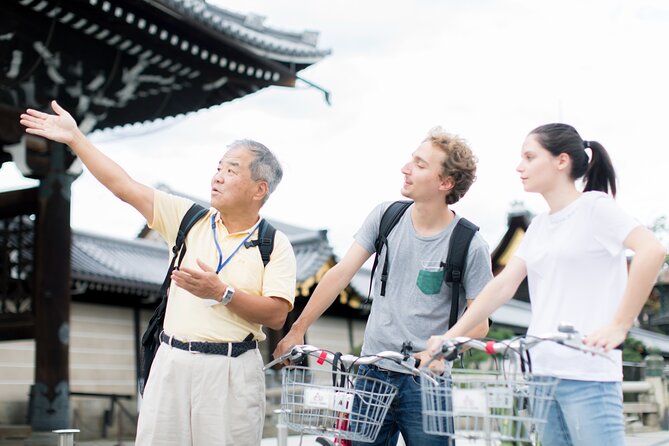
- Local-guide routing that prioritizes quiet backstreets far from the usual crowd lanes
- Professionally trained guides with traffic safety and group cycling technique
- Geisha districts on a bike: Miyagawacho and Gion, connected by alley to main-street contrasts
- Imperial Palace gardens by gravel path instead of just staring at a fence from the sidewalk
- Kamo River downtime at Kashiwayacho, built in as a relaxing stop
- Rain plan included: poncho biking continues, or you can switch to a walking tour using public transportation
Why Kyoto’s hidden alleys work better by bike (not bus)
Kyoto can feel like two cities at once. There’s the postcard Kyoto you already know, and then there’s the behind-the-houses Kyoto you only catch if you travel the way locals do—on foot for small stretches, but with wheels when the distances add up.
That’s where a guided bike format earns its keep. The tour is designed to move you through tight lanes where walking only would slow you down. And because it’s a scheduled, paced route, you’re not left guessing which streets connect naturally. You’re guided from Miyagawacho (one of Kyoto’s geisha districts) into Gion, then onward to calmer green spaces like the Imperial Palace grounds and the Kamo River area.
The best part is the contrast. Alleyway scents, the sound changes under different street walls, then suddenly you pop back into a main street scene. That shift is basically the point of the tour. If you like Kyoto as a sequence of moods—wooden houses, refined old-district feel, willow-lined water edges, and landscaped palace gardens—this makes it feel like one continuous afternoon instead of separate checklists.
You can also read our reviews of more tours and experiences in Kyoto.
Meet at 2:00 pm and roll into Kyoto’s backstreets
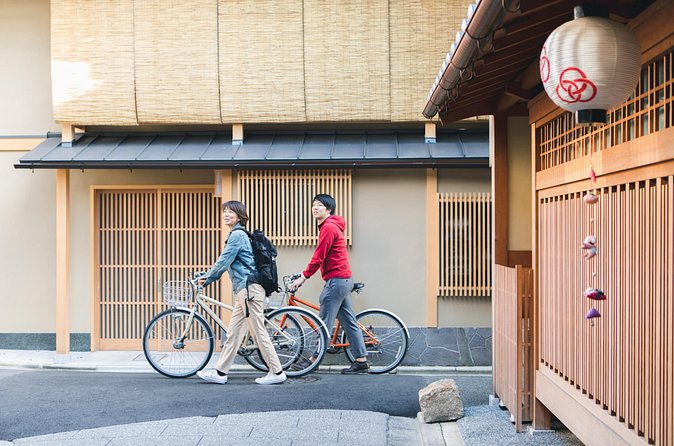
You’ll start from 552-13 Higashiaburanokōjichō, Shimogyo Ward, Kyoto (600-8235) at 2:00 pm. The tour runs about 3 hours and ends back at the meeting point.
Why that matters: an afternoon start is often a sweet spot. Morning crowds are sometimes already thinning, and late afternoon still has usable daylight for outside stops. Also, ending where you began makes it easier to match this with dinner plans without a complicated “now what?” moment.
This is also a private tour activity—your group rides together rather than getting mixed into a larger public group stream. The group size is capped per guide, so the route stays manageable for cycling and photo stops.
Miyagawacho Kaburenjo: quiet wooden lanes that feel lived-in
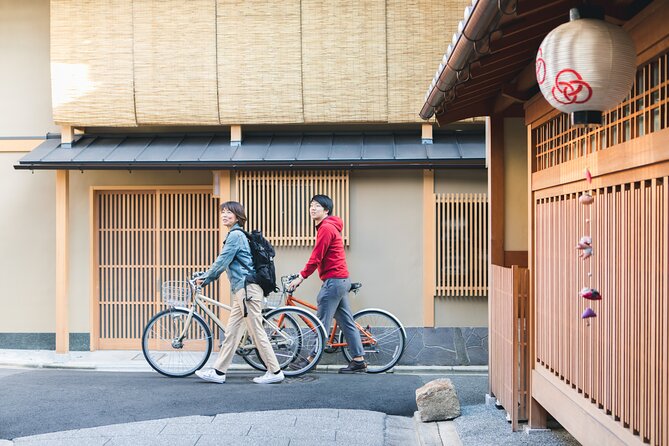
Your first stop is Miyagawacho Kaburenjo. Miyagawacho is described as the second biggest among Kyoto’s five geisha districts. Even without needing any special interpretation, the street scene itself tells you what to look for: traditional wooden houses lined on both sides of an alley.
This stop is short—about 15 minutes—but it’s timed well. You begin your tour in a calmer mood before cycling into the more famous name you’ve likely heard: Gion. That’s smart pacing. It helps you start noticing details—house textures, narrow lane perspective, and that subdued feeling you get when the street is more residential than sightseeing—before the tour becomes more “main character” Kyoto.
A quick consideration: because the lane environment is tight, you’ll want to keep your movement smooth. If you’re the type who stops abruptly for photos or struggles to balance on a bike at low speed, you’ll enjoy this less. The upside is that if you’re comfortable riding, the alley feeling is exactly why this tour exists.
Gion: refined geisha-district atmosphere in motion
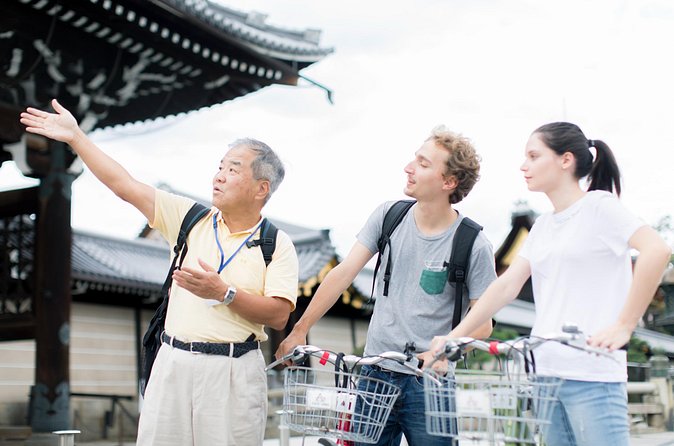
Next up is Gion, another 15-minute stop. Here the tour shifts from quiet wooden alleys into a more recognizable district identity. Gion grew as a major geisha district, with Maiko girls and Geiko women part of its historical and cultural image. The description emphasizes that the elegant, refined old-times atmosphere still lingers.
By bike, you see Gion differently than you would on a crowded walking strip. You’re moving at a pace that lets you notice the street feel without getting swallowed by foot traffic every few steps. And because the route is guided, you’re not just passing “famous corners”—you’re cycling through transitions: alley to main street, quiet to lively, side-street calm to the energy that surrounds this area.
What I’d watch for: Gion’s main streets can get busy. The bike route helps, but you’ll still want to be ready for pedestrian density at the moments when the tour reconnects with the familiar postcard Kyoto scene.
Tatsumi Bridge: willow-swinging water break for your senses
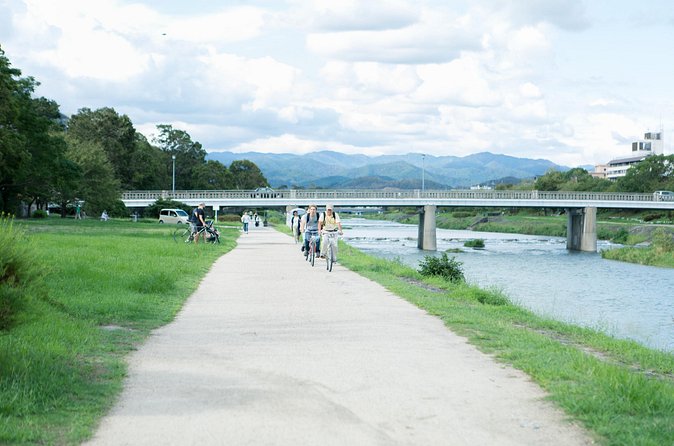
After the geisha-district segments, the tour takes you to Tatsumi Bridge for about 15 minutes. This is where the afternoon slows in tone. The path along the stream is described as giving your heart a refresh, with willows swinging in the breeze and a calmer feeling that contrasts the earlier district stops.
This stop is valuable because it resets your attention. When you’ve been riding through built-up streets and house-lined alleys, a water-and-tree pause helps you physically and mentally catch your breath. It also gives you something useful for photos: the light and perspective along a stream path tend to look different than the hard angles of city streets.
Practical note: you’re still on a bike tour schedule, so this isn’t a long sit-and-stare kind of break. Bring a bit of patience and enjoy it as a short nature “reset” before the palace gardens portion.
Kyoto Imperial Palace: gravel paths and seasonal garden time
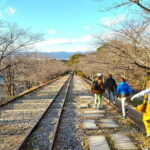
Then you cycle to the Kyoto Imperial Palace area for about 20 minutes. The palace used to be the residence of Japan’s Imperial Family, and today it’s open to the public as a national garden with seasonal flowers. The tour specifically notes that you cycle along the gravel paths there.
This detail is one of the big reasons to consider a bike tour here. If you’re just walking, you can spend time bouncing between gates and paths without really feeling the garden rhythm. Cycling along gravel paths (with your guide handling the safest route through the space) helps you cover more of the garden feel in a limited time window.
Possible drawback: the Imperial Palace area is a garden space, not a theme-park attraction. If you want lots of built-in “stop-and-learn” time at every corner, this portion may feel short. But as part of a 3-hour route that also includes geisha districts and Kamo River downtime, it hits a good balance.
Kashiwayacho and the Kamo River: a local-style wind-down
Your final stop is Kashiwayacho, where you can relax at the Kamo River. The timing is about 20 minutes, and this stop is marked as included.
This is a smart finish. The early part of the tour is about Kyoto’s district atmosphere—wood, old lanes, and refinement. The end is about breathing room. The Kamo River area gives you a chance to stop moving, let the city noise fade, and take in the local rhythm you can’t always get from temples alone.
If you’re planning the rest of your afternoon, use this time to decide where you’ll eat or wander next. You’ll be on the right side of town for a continuing Kyoto stroll, and you’ll be less rushed because the bike tour already handled the hard work of getting you between major zones.
Price and value: what about $102.47 gets you in 3 hours
At $102.47 per person for about 3 hours, the value depends on what you’re comparing it to.
Here’s what you’re really paying for:
- A private-group format (not a big mixed bus tour) that keeps the pacing sane
- A professionally trained guide with both cultural understanding and traffic safety competence
- Multi-zone routing that strings together Miyagawacho, Gion, Tatsumi Bridge, Kyoto Imperial Palace area, and a Kamo River relaxation stop
- Admission marked as free for the first four listed stops, plus the Kamo River stop being included
In other words, you’re not paying only for “being shown sights.” You’re paying for an afternoon plan that saves you from logistics headaches and from spending your best energy figuring out how to get from place to place efficiently.
Also, the average booking window is about 13 days in advance, and that usually means the tour is popular. If you want a specific date, don’t wait until the last minute.
Safety, group cycling, and why the guide matters more than you think
This tour’s guide training is one of the strongest selling points in the provided info. The guides are described as professionally trained through the provider’s original program, with full proficiency in:
- traffic safety
- group cycling techniques
- local etiquette
That isn’t just fine print. On a city bike tour, a lot can go wrong if the guide doesn’t manage lane choices, group spacing, and timing. You want to feel guided, not like you’re improvising bicycle navigation while also trying to enjoy historic streets.
The structure is also built for comfort. The tour accepts a minimum of 2 and a maximum of 6 guests per guide, and if the group is larger (7–12), an extra guide can be arranged. That helps keep the ride from turning into a “herding bikes through the city” situation.
One review detail that reinforces this: the guide Yuichi was highlighted as phenomenal—personal, informative, and funny. When a guide can combine clear safety leadership with genuine personality, the whole ride clicks into place.
The E-bike angle: easier effort, more Kyoto time
One review calls out the E-bike hype specifically, noting that riding through Kyoto streets and stopping at cultural/historical sites was excellent and that E bikes made the tour easier.
Even if you don’t know your bike comfort level right now, this matters. Electric assist can turn a potentially tiring afternoon into a steady, enjoyable ride—especially when Kyoto lanes include stop-and-go segments and you’re trying to focus on the view.
If you’re someone who gets tired quickly, or you’re traveling with family members who still want to cycle but can’t handle big hills, an E-bike setup is often the difference between enjoying the ride and wishing you booked a walking tour.
Rain plan: poncho biking or switch to public-transport walking
Kyoto weather can surprise you, so it’s good that the tour includes a rain strategy. The tour operates in rain, with two options:
1) Continue as usual on bikes with rain poncho (free of charge)
2) Switch to a walking tour using bus or metro (included in the tour fee)
That’s a big deal for planning. It means a rainy day doesn’t automatically become a ruined afternoon or a scramble to find something else. You’ll still get to follow the guided structure, just in a different movement mode.
What to do if you hate wet weather: wear shoes you don’t mind getting damp, and keep your valuables protected. A poncho helps, but you’ll still want to be practical.
Who should book this Hidden Alleyway afternoon ride
I think this tour is a strong match if you:
- want Kyoto’s district atmosphere without spending your whole day hopping between far-apart neighborhoods
- like the idea of geisha districts plus green breaks in one afternoon
- prefer guided cycling over DIY route-planning
- want a small-group feel with a guide trained in safety and local etiquette
It’s less ideal if:
- you’re not confident riding a bike in city conditions
- you want long, slow temple-style wandering with lots of extended time per stop
- you hate close-quarters movement in narrow lanes
Also, children must be at least 10 years old, 145 cm or above, and able to ride a bicycle safely on the road unassisted. If you’re traveling with kids, that’s a key filter.
Should you book this tour or skip it?
Book it if you want a well-paced, guided way to experience Kyoto’s mood shifts: wooden alley calm at Miyagawacho, the refined Gion vibe, a willow-lined stream pause, Imperial Palace gardens through gravel paths, then a Kamo River wind-down.
Skip it if you’re committed to slow, stop-everywhere sightseeing or you’re not comfortable riding in city traffic and narrow lanes. In those cases, walking-focused sightseeing might feel more relaxing.
Overall, for the time you get (about 3 hours) and the areas you hit, this is priced like a practical choice. The biggest reason I’d choose it is the combo of trained safety leadership and a route that deliberately connects “quiet Kyoto” with “famous Kyoto” in one ride.
FAQ
How long is the Hidden Alleyway with a Local Expert (Afternoon Tour)?
The tour runs for approximately 3 hours.
What time does the tour start?
The start time is 2:00 pm.
Where is the meeting point?
The meeting point is 552-13 Higashiaburanokōjichō, Shimogyo Ward, Kyoto, 600-8235, Japan. The tour ends back at the meeting point.
Is this tour private?
Yes. It’s described as a private tour/activity where only your group participates.
What stops are included?
The tour includes stops at Miyagawacho Kaburenjo, Gion, Tatsumi Bridge, the Kyoto Imperial Palace area, and Kashiwayacho for the Kamo River.
Does the tour run in the rain?
Yes. It will operate in rain, with options to continue on bikes with a rain poncho, or switch to a walking tour using bus or metro (included).
Is there a minimum group size or child requirement?
The tour accepts a minimum of 2 guests and a maximum of 6 per guide. Children must be at least 10 years old, 145 cm or above, and able to ride a bicycle safely on the road unassisted.